About this Short Film
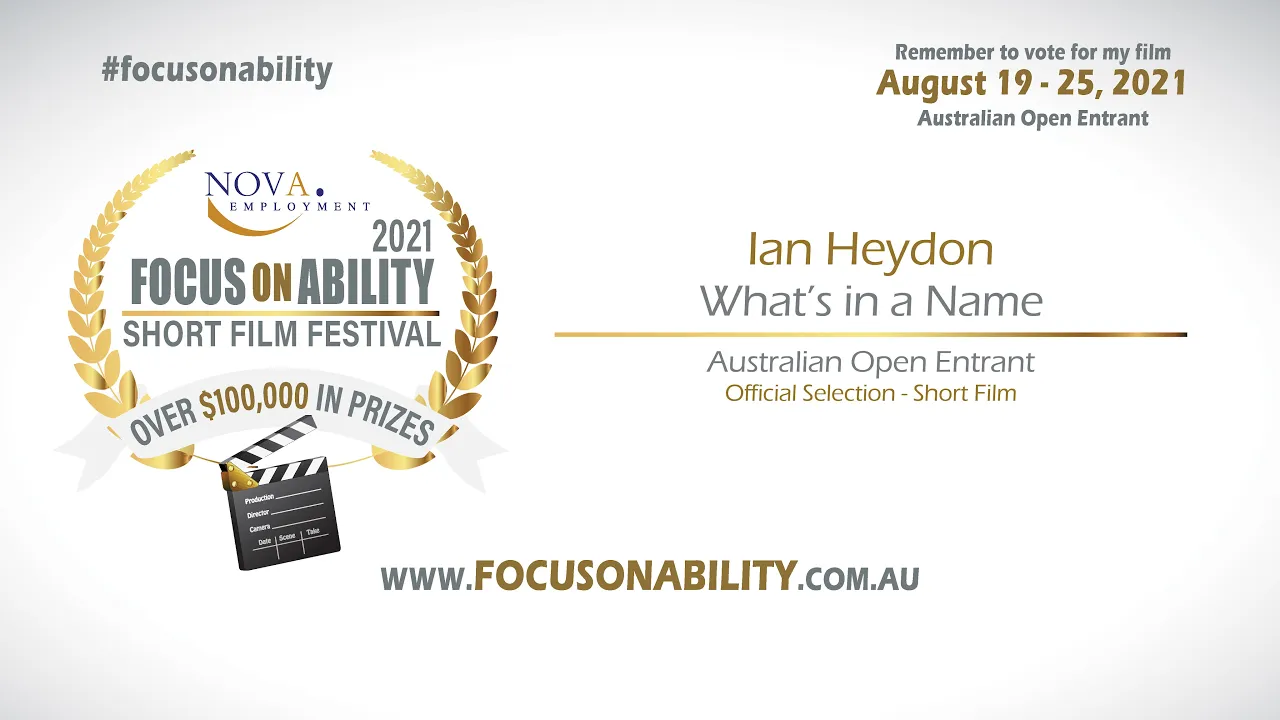
What’s in a Name (Ian Heydon, Australia, 2021) is a short film in our Focus on Ability programme that examines how language and labels shape everyday life. The film speaks to themes of cognitive processing disability, mobility and inclusion, and raises thoughtful questions about how we address and recognise one another. It does not prescribe answers, but invites viewers to notice the small moments where titles and words matter. Gentle and observant, this entry contributes to our festival’s aim of celebrating diverse perspectives and prompting conversations about respect, accessibility and individuality. Suitable for audiences interested in language, identity and inclusion.
Film Details
Film Transcript
Hi, welcome to What's in the Name. My name is Ian Hayden. I have multiple sclerosis, and part of this curious, complex chronic condition is that sometimes we lose who—what—it's what your callers call words. Yes, words. We just can't find the right word for an object or an occasion, and that can have added complications when your occupation is a writer. That might be a better title for it: at a loss for words.
I mean, everything has a name. For example, nerdl — a nerdl is the technical name for a blob of toothpaste. Petrichor describes that lovely smell of rain on dust, and aglet is the little metal or plastic tube at the end of a shoelace. And here's a word for you: cacoraphiophobia — that rolls off the tongue like sand, doesn't it? Cacoraphiophobia — that's the fear of failure. But there we know failure here, because I reckon that's worth about a thousand points on a triple word score.
The thing is, we don't know we're doing it, and our family and our friends and our colleagues think we're mad or stupid or have early onset dementia. I know a fellow MS-er who lost the word "table." She was inviting her family up for the Sunday roast and she wanted to say "everyone up at the table" and it came out as "everyone up at the big brown thing with the chairs around it." Another MS-er I know wanted to wish someone luck by saying "fingers crossed" and it came out as "thumbs together."
I was cooking an omelette for breakfast once and I wanted my wife to pass me the spatula, you know, the egg lifter, and it came out as "Darling, can you pass me the flippy stick?" Flippy stick. We decided that's a better name for it and it's now officially our flippy stick. I can hear that screaming out from morning television: "It's the K-Tel Flippy Stick! It flips, it slips, it shifts — you'll never run out of uses! Not available in stores, so call now! But wait, there's more! With every Flippy Stick you'll receive absolutely free the one, the only Stabby Crabby — exclusive to this amazing TV offer. Stabby Grammy!" "I've already got a fork."
I was playing Scrabble recently and I substituted the word "twitchies" for "tiles" and I went to the fridge to get saveloys and that came out as "squigglies." Those two words didn't take off. It's a pity, because some people wouldn't mind having this quickly switch with the Flippy Stick.
But seriously, it can be a real problem. There are people who work with MS who were afraid to speak up for fear of being discounted and made to feel foolish. That's all I'm trying to say. I mean, it should be as plain as the nose on your face, but cognitive problems aren't as obvious to the lay person as, for example, someone sitting in a wheelchair or having mobility problems like incontinence or the lot. I mean it's not rocket surgery. All we're asking is that people try to understand what we're talking about. We want doctors and other health authorities to be able to diagnose us correctly. We want the NDIS to subsidise speech pathologists, and we want everyday people like you who have a modicum of common sense to get behind us. So thumbs together, my friends, and good luck to us all.
[Music]
Filmmaker
Ian Heydon is the filmmaker behind this entry. See every Focus on Ability entry from Ian Heydon.